
Antiquity
Historical Significance
Sri Surya Pahar is believed to have flourished between the early centuries BCE and the medieval period, leaving behind monuments, sculptures, and artifacts that reveal a layered past. In absence of much other evidence, Its importance lies in its tri-religious presence, making it not only an archaeological wonder but also a cultural symbol of India’s unity in diversity.
(4th Century A.D. – 7th Century A.D.)
The Imperial Varman Consolidation
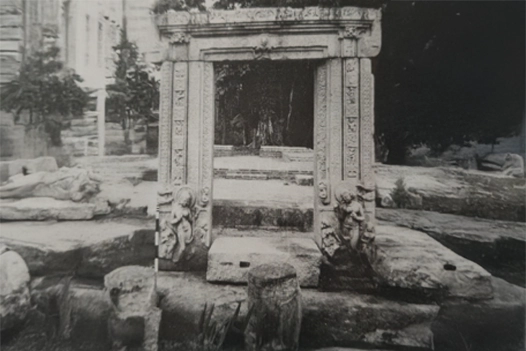
The authentic political history of Kamarupa (Ancient Assam) began with the establishment of the Varman Dynasty around the first half of the fourth century A.D. This era coincided with powerful influence from the Gupta Empire, whose supremacy extended over North Bengal from the mid-5th century into the later 6th century A.D.. This contact introduced sophisticated artistic techniques, seen in the excellent workmanship of the Gupta style, such as the Ganga-Yamuna Doorjamb.
(1st Century B.C. – 2nd Century A.D.)
The Sunga-Kushana Buddhist Continuity
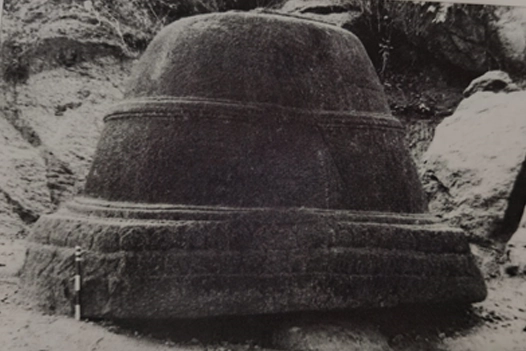
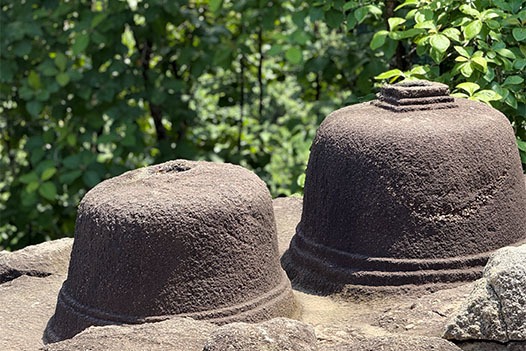
Following the initial period, religious activity continued in an unbroken sequence. The numerous rock-cut stupas found at the site, varying in size and shape, generally date from the 1st Century B.C. and continued thereafter. Some structures, such as a medium-sized stupa, are specifically reported to be datable to the Sunga-Kushana period.
(3rd Century B.C.)
The Dawn of Buddhist Era
Suryapahar holds the unique distinction of being the only site in Assam whose history extends back to the early Buddhist period in India, with clear evidence placing activity around the 1st Century B.C. However, the foundational architectural style suggests an even earlier influence from the Mauryan Empire.
(7th Century A.D. – 9th Century A.D.)
The Emergence of the Kamarupa School
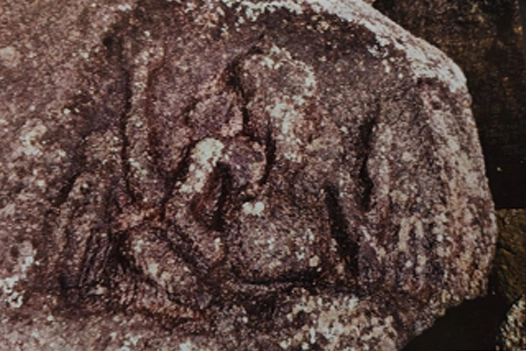
By the late 6th and early 7th centuries A.D., artists began forming a distinct "School of Sculpture" in the region, which developed its own unique style and technique. This period saw the flourishing of rock-cut iconography dedicated to major Hindu deities.
(9th Century A.D. – 11th Century A.D.)
The Mahayana and Panchayatana Synthesis
The final recorded phase demonstrates Suryapahar’s peak as a sacred syncretic hub. Jain Tirthankars were carved and revered during the 9th–10th Century A.D. Simultaneously, excavations uncovered evidence of a Hindu temple complex dedicated to the Panchayatana system.
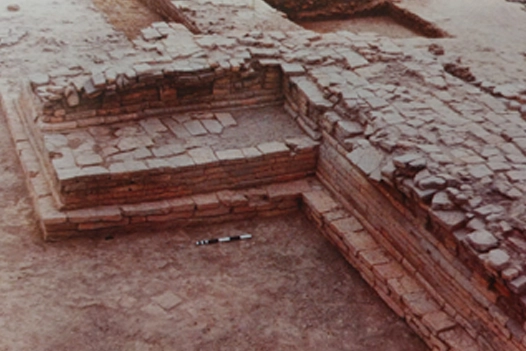
All antiquity images are credited to “Suryapahar, A Monument to Excellence by Milan K. Chauley.”